Data
Our current projects:

Can social connection, acceptance, and belonging reduce disparities in depression symptoms?
Project lead: Katherine N. Thompson
Major collaborators: Moritz Herle (King’s College London), Erin Dunn (Purdue, Dept of Sociology), Evelina T. Akimova (Purdue, Dept of Sociology), Shawn Bauldry (Purdue, Dept of Sociology), and Elisabeth Noland (University of Illinois Chicago)
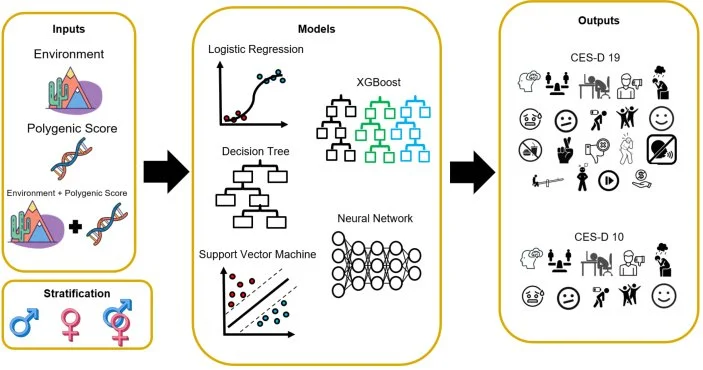
Objective: The overall aim of this project is to understand how social connection, acceptance, and inclusion in adolescence can mitigate the association between at-risk characteristics and depression symptoms in the short (one-year) and long term (one decade). We use the health disparity framework to estimate how social connection can mediate the association between genetic vulnerability, socio-economic position, sex, and race, and depression symptoms.

Gene-by-environment interactions in smoking: Insights from human genetics
Project lead: Yeongmi Jeong
Major collaborators: Michel Nivard (The University of Bristol), Andrea Ganna (University of Helsinki), Brad Verhulst (Texas A&M)
Objective: We explore gene by environment (G×E) interactions using the GWAS summary statistics for smoking initiation across contextual subgroups, including gender, region, and birthyear cohort.
Summary: This project investigates gene-by-environment (G×E) interactions in smoking behavior, with a focus on smoking initiation. While both genetic and environmental influences on smoking are well established, evidence for their interaction remains limited. The study aims to explore whether individuals with different genetic predispositions respond differently to environmental contexts that influence smoking behavior. Using GWAS summary statistics, the project examines smoking initiation across contextual subgroups defined by region, gender, and birth year. If confirmed, such interactions could provide valuable insights into the development of smoking, address public health concerns, and shed light on the broader debate over the relative roles of nature and nurture in shaping human behavior.

Integrative omics and statistical modeling for translational research in metabolic disorders
Project lead: Mulusew Fikere
Major collaborators: Timothy Ryan (Eli Lilly and Co.), Linsey Jackson (Eli Lilly and Co.), Pallav Bhatnagar (Eli Lilly and Co.), Corey James (Eli Lilly and Co.), Colm O'Dushlaine (Eli Lilly and Co.)
Objective: To integrate multi-omics and clinical data using statistical and computational modeling approaches to identify biological pathways, biomarkers, and therapeutic targets that support translational research and drug discovery in metabolic disorders.
Summary: This project integrates multi-omics and clinical data using statistical and computational modeling approaches to study metabolic disorders and support translational drug discovery. One of the key focuses is building a healthy-to-disease proteomic reference framework that allows patients to be positioned relative to normal molecular profiles, improving interpretation of disease progression and treatment response. The study will apply high-dimensional omics analyses, including empirical Bayes and Bayesian modeling approaches, to identify biomarkers, pathways, and therapeutic targets associated with metabolic health.

Mapping changes within physical and mental health comorbidity over time using a longitudinal cohort
Project lead: Aahan Bajpai
Major collaborators: Rafael Geurgas (Purdue, Dept of Sociology), Evelina Akimova (Purdue, Dept of Sociology), Katherine N. Thompson (University College London)
Objective: By mapping people's symptom-level experiences, we can glean unique, detailed insights into comorbidity patterns over time between physical and mental health. We aim to identify changes in physical and mental health comorbidity across time and to test for differences across stratifying variables, including genetic risk for depression, sex, chronic diagnoses, and socioeconomic status.
Summary: We use data from the National Longitudinal Study of Adolescent to Adult Health, a nationally representative sample surveyed from adolescent into adulthood across five time points. We use network analysis to document relationships between depression symptoms and symptoms of physical health, with a specific focus on sleep problems, anthropometric markers, and general physical health symptoms (e.g., headaches, chest pains, and aches). Specifically, we use Gaussian graphical modeling with LASSO regularization to estimate comorbidity within and across each wave.